Roth conversions are one of the most complex tax planning strategies available to retirees. Determining how much to convert has always been more complicated than simply looking at your current tax bracket.
A conversion increases taxable income, but it can also trigger higher Medicare premiums, reduce ACA premium tax credits, increase Medicare IRMAA surcharges, increase the taxation of Social Security benefits, trigger the Net Investment Income Tax, and create additional taxes if taxable assets must be sold to pay the conversion tax, an additional cost that is often overlooked.
Princeton Asset’s Income Tax Calculator can now compute the complete, all-in cost of a Roth conversion, capturing every dollar of additional tax and healthcare cost generated by the conversion itself.
In two previous articles, we explored different pieces of this puzzle.
In How Roth Conversions Affect ACA and IRMAA Subsidies, we showed that the cost of a Roth conversion extends well beyond federal income tax. Depending on your age and circumstances, additional income can reduce Affordable Care Act premium subsidies or increase Medicare IRMAA surcharges, making the effective cost of a conversion significantly higher than many investors expect.
Later, in Building Wade Pfau-Style Tax Maps with Princeton Asset’s Income Tax Calculator, we introduced tax maps that visualize how taxes and healthcare costs change as income increases. Rather than focusing on a single marginal tax bracket, tax maps reveal where “tax cliffs” and hidden marginal rates occur, allowing retirees to identify windows where additional income is relatively inexpensive and avoid areas where every extra dollar becomes surprisingly costly.
This article explains how the all-in Roth conversion cost calculation works and why it provides an accurate basis for Roth conversion planning.
The All-In Roth Conversion Cost
Suppose you decide to convert from a Traditional IRA to a Roth IRA.
If you have sufficient cash outside of retirement accounts to pay the tax, the analysis is relatively straightforward. The Roth conversion cost represents a reduction in your taxable assets while the full conversion amount moves into the Roth account. This case is explained in detail in Building Wade Pfau-Style Tax Maps with Princeton Asset’s Income Tax Calculator article.
However, many retirees don’t have the amount of conversion tax available in cash. Instead they will need to produce that additional cash by selling assets to cover the Roth conversion cost. Thus additional funds must be withdrawn or sold to generate the cash needed to pay the cost of asset liquidation and the cost of the Roth conversion.
Extending the Effective Marginal Rate
Princeton Asset’s Income Tax Calculator extends the Effective Marginal Rate (EMR) framework to capture the additional economic cost associated with generating the cash needed to pay the conversion tax.
This produces a more complete estimate of the all-in cost of converting another dollar from a Traditional IRA to a Roth IRA.
Investors comparing multiple conversion amounts can chart the EMR values to provide a realistic picture of the cost involved in each scenario.
By incorporating taxes, healthcare impacts, and the cost of funding them, the analysis will tell you exactly how much the Roth conversion will cost.
That is ultimately what effective marginal rates—and tax maps—are designed to answer.
Calculating the All-In Roth Conversion Cost
We will list the steps first and then show an example but first the main idea:
To compute the all‑in cost of a Roth conversion you need to run three distinct scenarios and compare them sequentially.
Start by entering your baseline income (no conversion) and recording the total tax and healthcare premiums. Next, add your proposed conversion amount to that baseline; the increase in taxes and healthcare premiums is your apparent conversion cost. However, if you don’t have cash on hand to pay that cost, you must sell taxable assets to fund it—and those sales generate additional capital gains, which create more tax and potentially higher healthcare costs. To capture this ripple effect, take the apparent cost from step two then add that extra amount to your income in the calculator. This will show a second increase in taxes and premiums relative to the Roth conversion case. Finally, add that second‑round increase to the “Other Healthcare Annual Premium” field in the calculator for the Roth conversion tax scenario. The difference between this final total cost (total tax + healthcare premium) and your baseline is your true, all‑in Roth conversion cost—the number that reflects every dollar of income tax, ACA subsidy loss, IRMAA surcharge, and tax‑on‑tax from funding the conversion itself.
The additional funds needed to pay the conversion tax are themselves subject to the same effective marginal rate as any other additional income. By iteratively increasing the taxable withdrawal until the withdrawal equals its own tax cost, the calculator converges on the total amount of taxable assets that must be liquidated to fully fund the conversion. This amount represents the complete current economic cost of the Roth conversion.
Steps:
- Baseline scenario.
- Roth conversion scenario.
- Measure incremental cost between 2 and 1.
- Add taxable income to fund that cost. Increase taxable income until the additional income equals the additional tax it creates relative to point 2.
- Reload the Roth conversion scenario. Add the additional funding cost under “Other Healthcare Premium” input.
- Compare 5 with baseline.
The “Other Healthcare Annual Premium” field is simply used as a convenient placeholder for the additional funding cost. Since it is included in the calculator’s total cost computation without affecting taxable income, it allows the complete all-in conversion cost to be visualized on the tax map.
We now have a tax map with 3 points Baseline, Roth conversion, Roth conversion + additional cost in the “Other Healthcare Annual Premium” input field which is the true cost of the Roth conversion.
Let’s review now the Example 2 from our previous article on EMR. Early retired couple (MFJ) from NJ with 2 kids. Baseline income: $60K in long term capital gains, $15K in non-qualified dividends and $45K in qualified dividends.
- For baseline: total tax is $3,578.75 and healthcare premiums: $11,952.00. (add to chart)
- Baseline + $10K Roth conversion: total tax: $4,131.25, healthcare premiums:
$30,000.00. (add to chart) - Total Roth conversion cost (difference): $18,600.50
- Let’s fund this with long term capital gains (LTCG) that have a 50% cost basis. We add to point 2 $9,300 in principal and $9,300 in LTCG.
- For point 4 we have now $4,645.08 in total tax and $30,000.00 in healthcare premiums. That is an additional $513.83 tax cost relative to point 2 which needs to be covered by increasing the amount of capital gains and principal by ~$265 giving a total tax of: 4,659.72 and cost diff relative to point 2 of ~$528.7.
- Now double click on second point in the chart to reload that chart scenario and add $529 in the “Other Healthcare Annual Premium” field and add that tax scenario to the chart as point 3. Note that compared with point 2 the EMR grew from 186.01% to 191.3%.
| Scenario | Total Tax | Healthcare | Total Cost |
| Baseline | $3,579 | $11,952 | $15,531 |
| +10K Conversion | $4,131 | $30,000 | $34,131 |
| All-in Conversion (*) | $4,131 | $30,529 | $34,660 |
(*) $529 is the additional cost of $9,565.00 in LTCG to cover the conversion and additional income cost.
Although the Roth conversion amount remains $10,000, once the cost of funding the conversion tax is included, the effective marginal rate rises from 186.0% to 191.3%. In other words, every additional dollar converted ultimately costs slightly more than initially estimated because the funds used to pay the tax also generate tax.
We saved this All-In Roth Conversion Tax-Map example here.
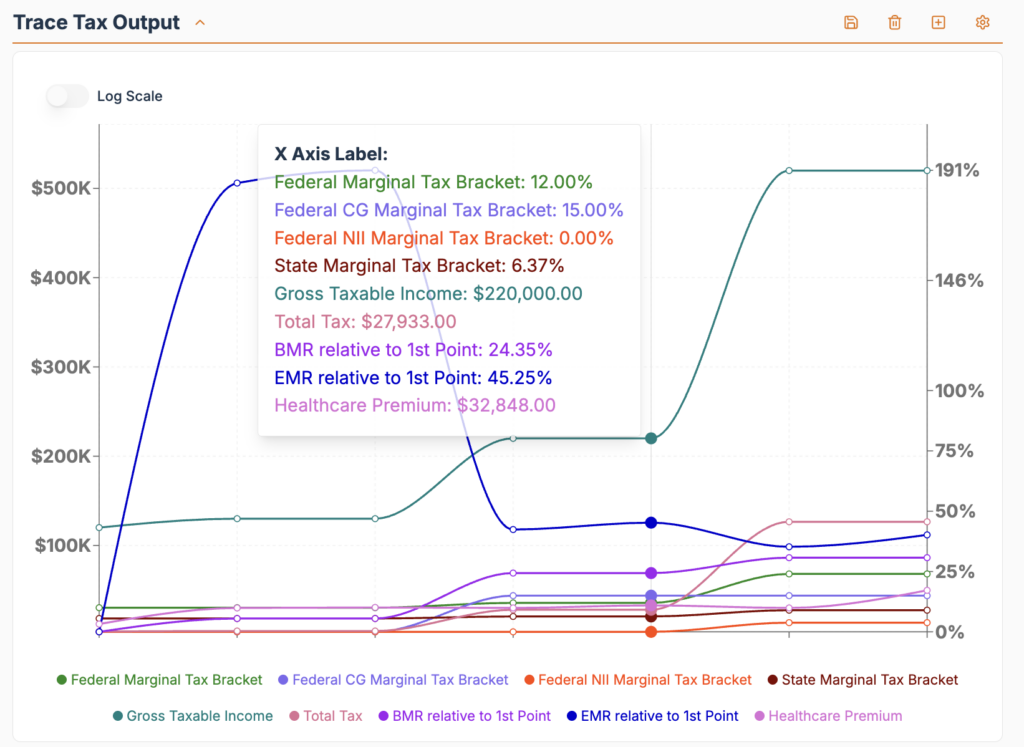
We also added to the example the All-In Roth conversion cost for $100K which raises that EMR from 42.4% to 45.25% and for a Roth conversion of $400K which raises the EMR from 35.25% to 40.18%.
Bringing Precision to Roth Conversion Decisions
Roth conversions are one of the most complex tax-planning strategies. But as tax laws and healthcare rules have become increasingly interconnected, accurately measuring their cost has become much more challenging.
By extending the Effective Marginal Rate framework to include the cost of paying the conversion tax itself from taxable income sources, Princeton Asset’s Income Tax Calculator can provide a more complete picture of the true price of a Roth conversion.
Investors can now determine the exact all-in cost for their Roth conversion.
For many planning decisions, that’s the number that matters most.
As Princeton Asset’s Income Tax Calculator continues to evolve, the goal remains the same: helping DIY investors visualize the complete economic impact of various financial scenarios so they can make more informed decisions.
Disclaimer: This blog post is for informational purposes only and should not be considered financial advice. Past performance is not a guarantee of future results. Consult with a qualified financial advisor for personalized guidance.
Leave a Reply